
Hello, Visitor from another Star!
www.deerfieldfocalpoint.com/articles/hello-visitor-from-another-star
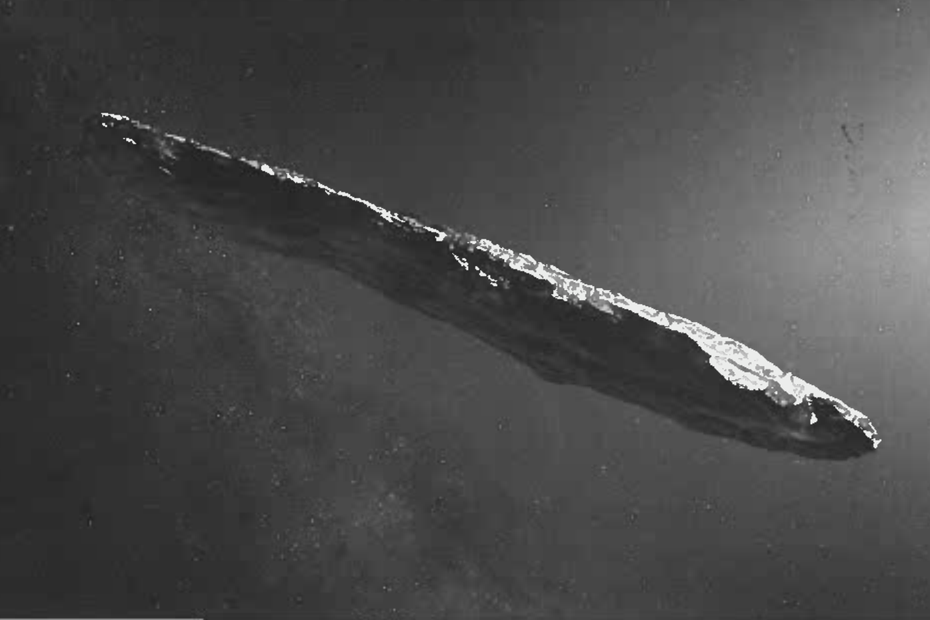
On October 19th, the Pan-STARRS 1 telescope in Hawaii observed something never seen before — an asteroid that had entered our Solar System from interstellar space. Astronomers from observatories worldwide scrapped their observing plans to welcome this unique visitor before it zipped out of the inner solar system. According to Karen Meech’s article in Nature, this is the first observed object originating from outside our solar system!
Formally designated as A/2017 UI by the International Astronomical Union, the asteroid is known as “‘Oumuamua,” meaning “a messenger that reaches out from the distant past.” Moving rapidly at a pace of 85,700 miles per hour, astronomers thought the faint light was just another comet from our solar system. Based on its orbit, however, the astronomers soon realized that the object came from interstellar space.
“For decades we’ve theorized that such interstellar objects are out there in our solar system, and now — for the first time — we have direct evidence they exist,” reports Thomas Zurbuchen, associate administrator for NASA’s Science Mission Directorate. Zurbuchen believes that “this history-making discovery is opening a new window for studying the formation of solar systems beyond our own.”
Multiple telescopes, including ESO’s Very Large Telescope (VLT) in Chile and other observatories around the world, focused in on the object for three nights to determine what it was before it moved out of sight. The telescopes was able to gather and analyze information and data on the object’s orbit, brightness, and color.
A team of astronomers led by Karen Meech of the Institute for Astronomy in Hawaii observed that ‘Oumuamua varies in brightness by a factor of ten as it spins on its axis every 7.3 hours. “This unusually big variation in brightness means that the object is highly elongated: about ten times as long as it is wide, with a complex, convoluted shape,” said Meech. These properties also suggest that ‘Oumuamua is dense, possibly rocky or with high metal content, lacks significant amounts of water or ice and that its surface is now dark and reddened due to the effects of irradiation from cosmic rays over millions of years. No known asteroid or comet from our solar system has been observed to vary so widely in brightness, with such a large ratio between length and width. While Omuamua’s elongated shape is unusual, it may provide new clues into the formation of other solar systems.

Preliminary orbital calculations suggested that the object had come from the approximate direction of the bright star Vega, in the northern constellation of Lyra. Even though it traveled at breakneck speed, it took so long for the interstellar object to make the journey to our Solar System that Vega is now at a different position from when the asteroid was there about 300,000 years ago. NASA believes that this unusual object had been wandering through the Milky Way, unattached to any star system, for hundreds of millions of years before its chance encounters with our star system.
Astronomers estimate that an interstellar asteroid similar to ‘Oumuamua passes through the inner Solar System about once per year, but they are faint and hard to spot and so have been missed until now. Only recently have survey telescopes, such as Pan-STARRS, been powerful enough to have a chance at discovering them. “We are fortunate that our sky survey telescope was looking in the right place at the right time to capture this historic moment,” NASA Planetary Defense Officer Lindley Johnson said in a statement. “This serendipitous discovery is bonus science enabled by NASA’s efforts to find, track and characterize near-Earth objects that could potentially pose a threat to our planet.”
‘Oumuamua is indeed a strange visitor from a faraway star system. Nonetheless, astronomers hope that they can observe more objects like this in the future. “We are continuing to observe this unique object,” concludes Olivier Hainaut, “and we hope to more accurately pin down where it came from and where it is going next on its tour of the galaxy. And now that we have found the first interstellar rock, we are getting ready for the next ones!”
As for the rest of us in this rapidly advancing society? It is time to reach farther than the stars.
Notes
- Talbert, T. (2017, November 20). Solar System's First Interstellar Visitor Dazzles Scientists. Retrieved from https://www.nasa.gov/feature/solar-system-s-first-interstellar-visitor-dazzles-scientists Back
- Clark, S. (2017, November 20). Mysterious object confirmed to be from another solar system. Retrieved from https://www.theguardian.com/science/across-the-universe/2017/nov/20/interstellar-object-confirmed-to-be-from-another-solar-system Back
- Guarino, B. (2017, December 15). Visitor from beyond our solar system probed for signs of life. So far, it's silent. Retrieved from https://www.washingtonpost.com/news/speaking-of-science/wp/2017/12/12/is-this-visitor-from-beyond-our-solar-system-an-asteroid-or-a-sign-of-life/?utm_term=.27a904c2f5d5 Back
- Koren, M. (2017, December 11). Astronomers to Check Mysterious Interstellar Object for Signs of Technology. Retrieved from https://www.theatlantic.com/science/archive/2017/12/yuri-milner-oumuamua-interstellar-asteroid/547985/ Back


